
The practice of shore fishing with lures is one of the most accessible ways for those who wish to discover sea fishing. Sea fishing with lures allows you to target a large number of fish. Whether it's the bass, the pollack, the ballan or the meagre, all of them can be caught on lures from the shore. If you'd like to discover shore lure fishing at sea, here's our guide to take you through the essential aspects of this type of fishing.
Our article in brief:
Shore fishing with lures is one of the most accessible forms of fishing for anyone wishing to discover sea angling. Here's the essential information to bear in mind:
- Essential equipment rod 2m20-2m70, reel 2500-4000, fine braid 9-11/100
- Effective lures : shads and soft lures, jerkbaits and hard lures of 8-15 cm, or casting jigs.
- Working your lures : steady retrieve, twitching, lift-and-drop
- Take the conditions into account: Favour the first and last hours of the day. Vary the areas and take account of the tide phases.
The equipment you need to start lure fishing from the shore
To get off to a good start lure fishing at sea, it's important to choose the right equipment. A rod from 2m20 to 2m70 with a tip action is a good compromise between sensitivity and casting power. It will allow you to detect the most subtle bites while propelling your lures to a good distance.
The choice of reel is just as important. Generally speaking, we go for dedicated spinning reels in size 3000 to 4000. Also choose a reel with a good retrieve rate to ensure perfect control of your lure as you work it, but also of your fish during the fight.
For the main line, we recommend using a 9 to 11/100 fine braid. Braid will allow you to reach longer distances than traditional nylon. What's more, the non-elasticity and sensitivity of the braid will allow you to feel the slightest vibration of your lure. Don't forget to use a fluorocarbon leader of 18 to 27/100 for greater discretion in the face of wary fish.
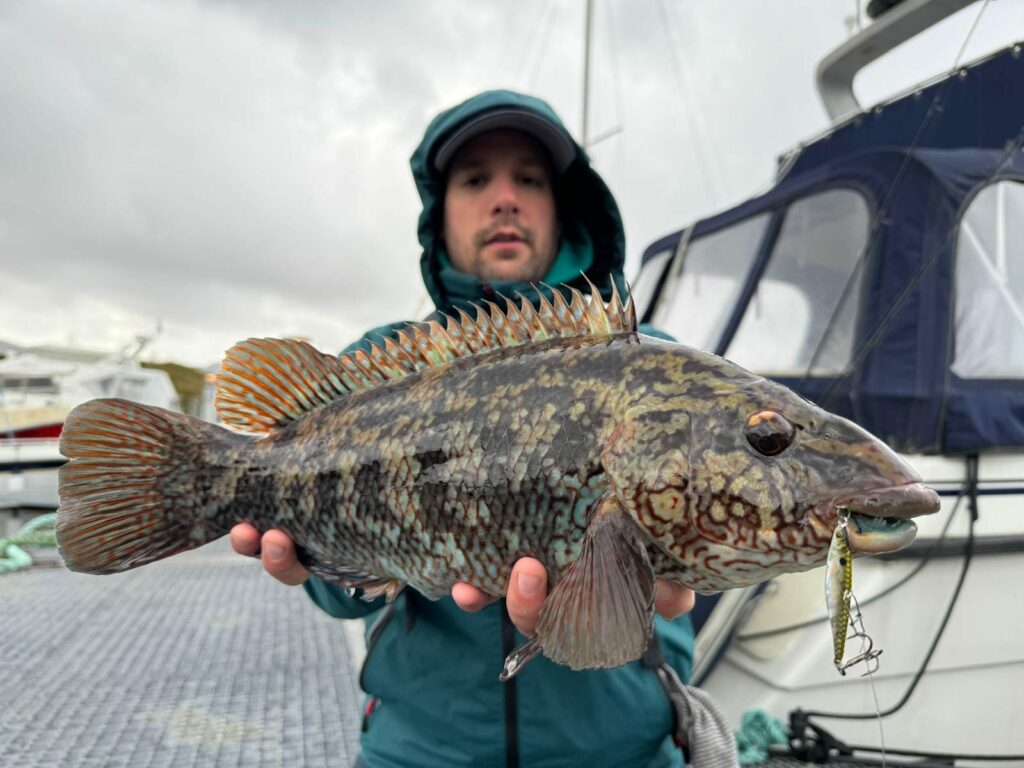
Here is a summary table of the basic equipment for sea fishing with lures:
| Equipment | Recommended features |
|---|---|
| Rod | 2m20 to 2m70, Medium to Medium-Heavy with tip action |
| Reel | Size 3000-4000 |
| Line | Braid 9-11/100 + fluorocarbon leader 18-27/100 |
How do you choose and work your lures at sea?
Lure selection is crucial to the success of your shore fishing sessions at sea. The 3 types of lure we favour for sea fishing are as follows:
- The soft lures Shads and slugs are the most common.
- Hard lures: Stickbaits for surface fishing and jerkbaits for deeper fishing
- Metal lures: Jigs and casting jigs
Our selection of lures for shore fishing
- Xorus Asturie: One of the best stickbaits for surface fishing
- Tackle House Feed Popper: The best saltwater popper to date
- Tiemco Salty Red Pepper: A silent stickbait for difficult fishing
- Heddon Super Spook: A surface lure that's as effective as it is economical for the wallet
- Megabass Vision 110 SW: The best sea lure in the jerkbait category
- Megabass Super X Layer: A formidable soft lure that every shore angler should have
- Fiiish Black Minnow 120 Shore: A soft lure ideal for fishing very snaggy spots
- DUO Drag Metal Cast: A casting jig ideal for sea fishing
- Megabass Dark Sleeper: A lure dedicated to rocky areas

Working the lures
When it comes to working them, each lure has its own characteristics. In short, we'd say that soft lures can be fished with a steady retrieve, lift-and-drop, on the drop or by scraping the bottom. You can also read our article on fishing with soft lures at sea.
Hard lures are generally worked with sharp flicks of the rod tip interspersed with longer or shorter pauses. Metal lures are a bit of a mix of the two, between fast jerky retrieves and slow lifts to cover the whole water column.
During a recent outing in the Cotentin, we experimented with different retrieves and got excellent results by varying the retrieve speed and swimming depth.

How to get the most out of lure fishing at sea?
To perfect your approach to shore fishing with lures, it's a good idea to master certain techniques. The rockfishing, for example, is an excellent way to get into sea fishing more easily. This technique involves fishing right next to the rocks, where many species hide. They are not usually the biggest, but they are present in large numbers.
Here are a few more tips to improve your results:
- Preferably fish in the early and late hours of the day, or even at night. Unlike in fresh water, night fishing is allowed at sea.
- Watch out for bites, which can be subtle
- Don't hesitate to change spots if bites are scarce

We recently tested these techniques during a night session on the Brittany coast. The combination of a soft white lure mounted on a 15g jig head, animated by short jerks close to the bottom, enabled us to catch several good-sized bass.
Respecting the environment and regulations
Shore fishing with lures must respect the environment and the regulations. Do you know the minimum catch sizes for each species? It's crucial! Not only does it keep us out of trouble. Above all, it allows our scaly friends to grow and reproduce.
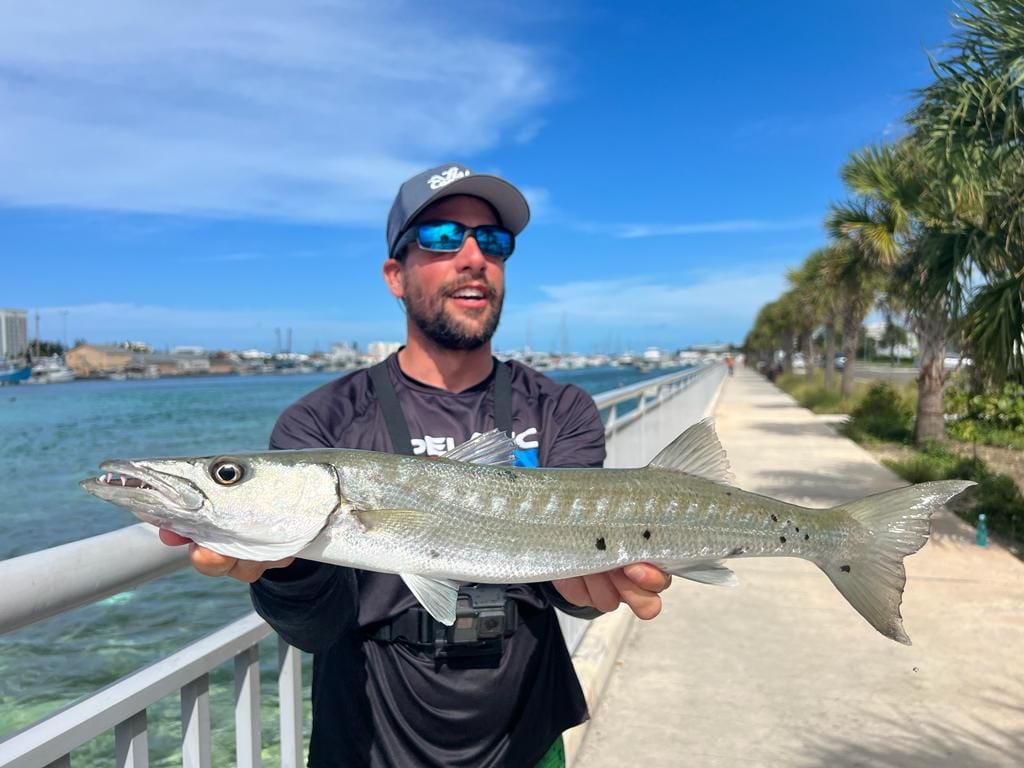
And if you're lucky enough to land a nice catch, but don't plan to eat it, why not offer it a return ticket to the big blue? It's a simple gesture that makes all the difference. Also remember to handle your fish with care. As fishermen, we are in a way the guardians of the sea. It's our playground, our source of wonder. So let's look after it! A little gesture here (picking up litter), a little gesture there (respecting the flora and fauna), and we can all help to keep our spots as beautiful as they were on the first day.
Together, let's make sure that fishing remains the moment of pleasure and connection with nature that we love so much. Who knows, maybe one day it will be our children or grandchildren casting their lines from that same rock, with the same wonder in their eyes?