
Fishkeeping is a hobby that appeals to more and more nature lovers. Watching a living, balanced and colourful aquarium offers a genuine moment of escape every day. Among the many species available, barbs hold a special place thanks to their lively behaviour and how easy they are to keep. You still need to understand their needs properly before bringing them home.
To discover the main species of barb fish and better understand their characteristics, it is worth consulting specialist resources that present the different varieties available for the aquarium.
Contents
Barbs: particularly endearing freshwater fish
Barbs belong to the large Cyprinidae family, which also includes the well-known carp and danios. Mainly native to South-East Asia, but also to Sri Lanka and parts of India, they naturally live in shallow rivers, calm streams and heavily vegetated areas.
They are particularly popular fish for several reasons:
- their often very bright colours;
- their energetic swimming;
- their shoaling behaviour;
- their hardiness when kept in good conditions.
Unlike some more discreet species, barbs constantly liven up the aquarium. They swim in groups, explore their surroundings and put on a non-stop show.
Why are barbs so popular with fishkeepers?
The success of barbs is not down to their looks alone.
They also have several advantages that appeal to beginners and experienced fishkeepers alike.
A wide diversity of species
The name “barbs” covers many species whose sizes, colours and behaviour differ considerably.
Among the most popular are:
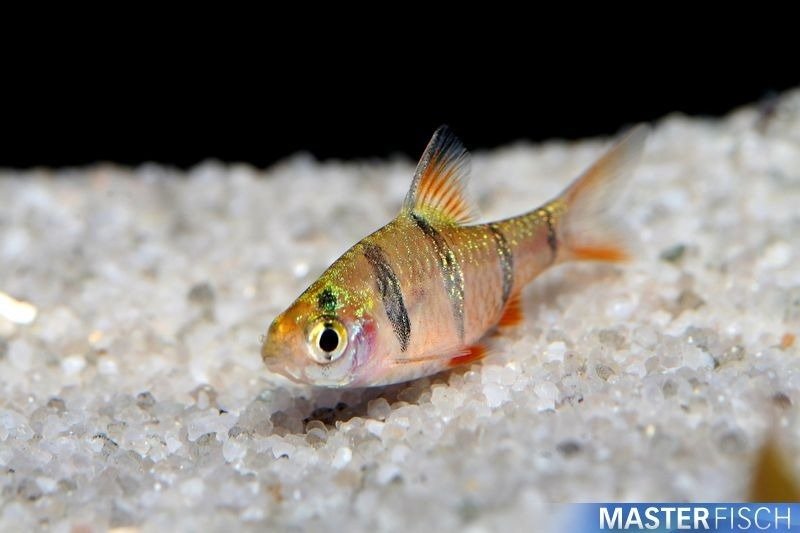
- the Tiger barb, recognisable by its vertical black bands;
- the Cherry barb (Puntius titteya), known for the magnificent red colouring of the males;
- the Five-banded barb (Barbus pentazona), calmer and particularly well suited to community tanks;
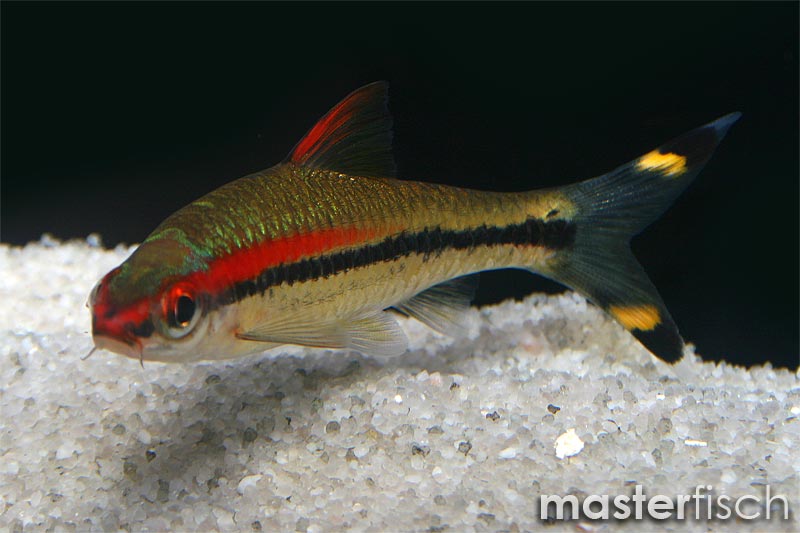
- the spectacular Denison barb (Barbus denisonii), easy to identify thanks to its characteristic red stripe.
This diversity means you can find a species suited to a small planted aquarium as well as to a much larger tank.
Very active fish
One of the main assets of barbs is their behaviour.
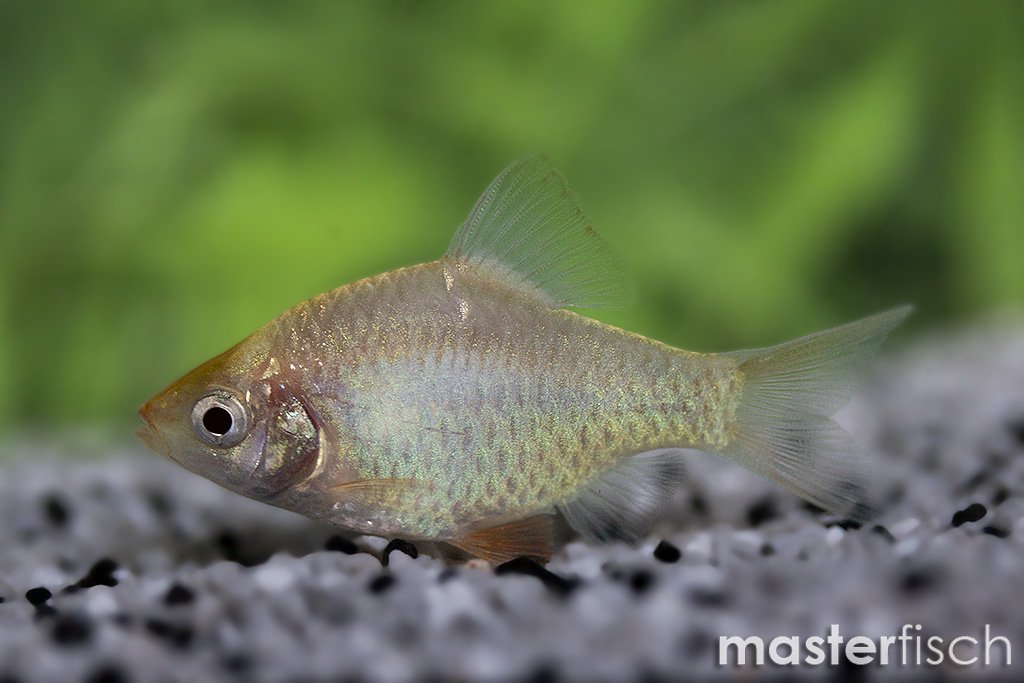
Always on the move, they explore every corner of the aquascape and constantly move about as a group. This permanent activity brings a great deal of life to an aquarium.
On the other hand, this energy also calls for some care when choosing their tankmates.
Some species, notably the Tiger barb, can tend to nip the long fins of calmer fish such as fancy goldfish, gouramis or angelfish.
It is therefore best to choose companions of a similar size that are lively enough.
What aquarium do barbs need?
Even though some barbs remain relatively small, they need a well-designed environment.
A sufficiently spacious tank
The first mistake is often to underestimate how much space they need.
Most species appreciate long, open swimming areas so they can express their natural behaviour.
Depending on the species chosen, a tank of 60 to over 200 litres may be needed.
The largest varieties, such as the Denison barb or Balantiocheilos melanopterus, require particularly spacious aquariums.
Abundant planting
In their natural habitat, barbs move among aquatic plants, roots and submerged branches.
Recreating this setting gives them a reassuring environment.
The ideal is to alternate:
- open spaces for swimming;
- tall plants;
- a few pieces of natural root;
- hiding places where they can rest.
This mix also reduces stress and encourages natural interactions within the group.
Water parameters to respect
Like many tropical fish, barbs appreciate relatively stable water.
The generally recommended parameters are:
| Parameter | Recommended value |
|---|---|
| Temperature | 24 to 26 °C |
| pH | 6.5 to 7.5 |
| Hardness | Average |
| Current | Low to moderate |
Efficient filtration is essential, as these fish are very active and produce a significant amount of organic waste.
Regular water changes will also help maintain excellent water quality.
Barbs live in shoals
This is probably the most important point to remember.
Barbs are shoaling fish.
They should never be kept on their own.
A group of six is generally the bare minimum, although eight to ten fish will show much more natural behaviour.
When they live in sufficient numbers, there are plenty of interactions:
- playful chasing;
- social hierarchy;
- synchronised movement;
- display behaviour.
Conversely, a lone fish quickly becomes stressed and may become aggressive towards the other inhabitants of the aquarium.
What should you feed them?
Barbs are omnivores.
In the wild, they eat small invertebrates as well as plants and larvae.
In the aquarium, their diet should remain varied to preserve their health and colours.
You can alternate:
- quality pellets;
- suitable flakes;
- brine shrimp;
- daphnia;
- bloodworm;
- frozen food.
A little plant matter, such as blanched vegetables or certain specific preparations, also helps round out their diet.
A balanced diet directly contributes to their growth, longevity and vitality.
Can barbs be bred in the aquarium?
Breeding is perfectly feasible, although it requires a few precautions.
Barbs generally lay their eggs among fine-leaved plants or on a suitable spawning medium.
Unlike other species, they provide no parental care.
On the contrary, they may quickly eat their own eggs after spawning.
To improve the chances of success, fishkeepers often use a dedicated breeding tank from which the adults are removed immediately after spawning.
The fry can then be fed gradually on infusoria and then brine shrimp nauplii.
A few common mistakes to avoid
Certain mistakes come up regularly among beginners.
Avoiding them helps keep your fish in good health for many years.
The main ones are:
- choosing a tank that is too small;
- keeping too few barbs;
- mixing certain species with long-finned fish;
- neglecting water quality;
- offering a poorly varied diet.
By following these few simple principles, barbs generally prove hardy and relatively easy to keep.
Perfect fish for a lively aquarium
Barbs win people over as much with their colours as with their behaviour. Always on the move, sociable and relatively easy to keep, they are an excellent choice for fishkeepers who want to create a lively, natural-looking aquarium.
Their well-being nevertheless depends on a few essential rules: a sufficiently spacious tank, a group of several fish, good-quality water and a varied diet. Once these conditions are met, these fish reveal their full personality and put on a fascinating show every day.
Finally, taking the time to observe your fish every day remains one of the best ways to quickly spot a change in behaviour or a possible health problem. Regular monitoring, combined with rigorous tank maintenance, lets you enjoy a balanced environment and thriving fish for many years.


