Massive, curious and surprisingly tame towards anyone who knows how to approach it on a breath-hold dive, the grouper , or dusky grouper, is one of the most iconic figures of the Mediterranean’s rocky seabeds. This large serranid (Epinephelus marginatus) with its stocky body and marbled livery fascinates divers just as much as it has now become a true symbol of the recovery of our marine ecosystems. Long decimated by overfishing, it is now strictly protected along the French Mediterranean coast.
In this species profile, we cover everything you need to know about this fish: its morphology, habitat, diet, remarkable reproductive cycle, the regulations that govern it, and the particular context of fishing for it — now very restricted, if not prohibited outright. Our angle is clearly one of respect and conservation.
Our article in brief
- The grouper , or dusky grouper (Epinephelus marginatus) is a large fish of the Mediterranean’s rocky seabeds, recognisable by its massive body and brown livery marbled with pale blotches.
- It commonly measures 40 to 80 cm, with the largest specimens exceeding 1.20 m and 50 kg, and it can live for up to 50 years.
- A protogynous hermaphrodite, it is born female and becomes male at around 10 to 14 years old: a life cycle that makes it particularly vulnerable to overfishing.
- Fishing for it is under a moratorium in French Mediterranean waters: spearfishing and hook-and-line fishing are banned until December 2033.
- Listed as “Endangered” on the IUCN Red List, it is gradually returning to our shores thanks to protection: a species to observe, not to catch.
Grouper morphology and identification
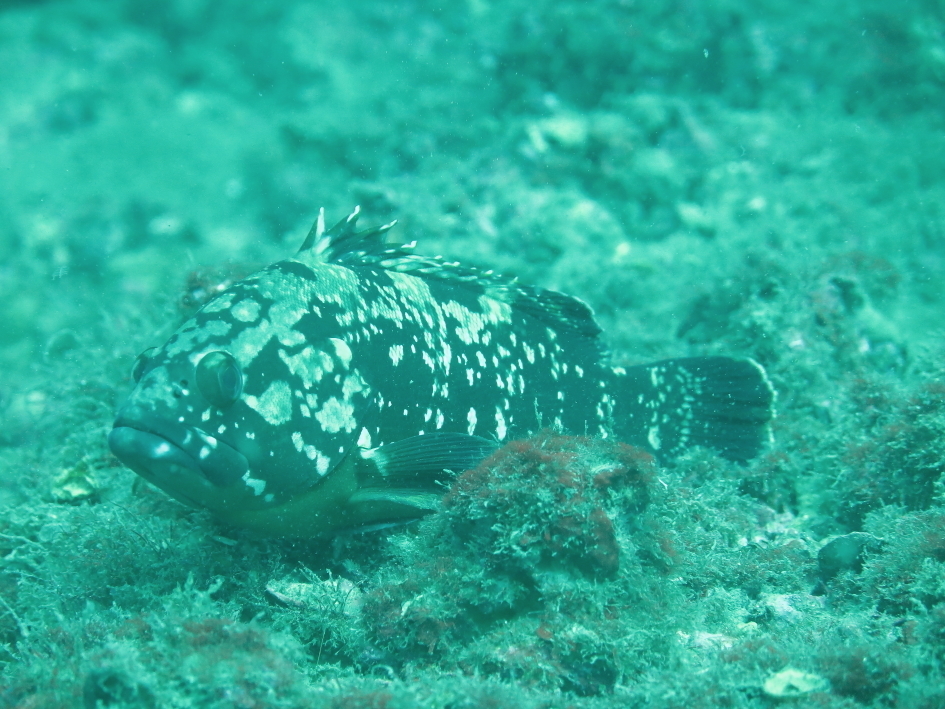
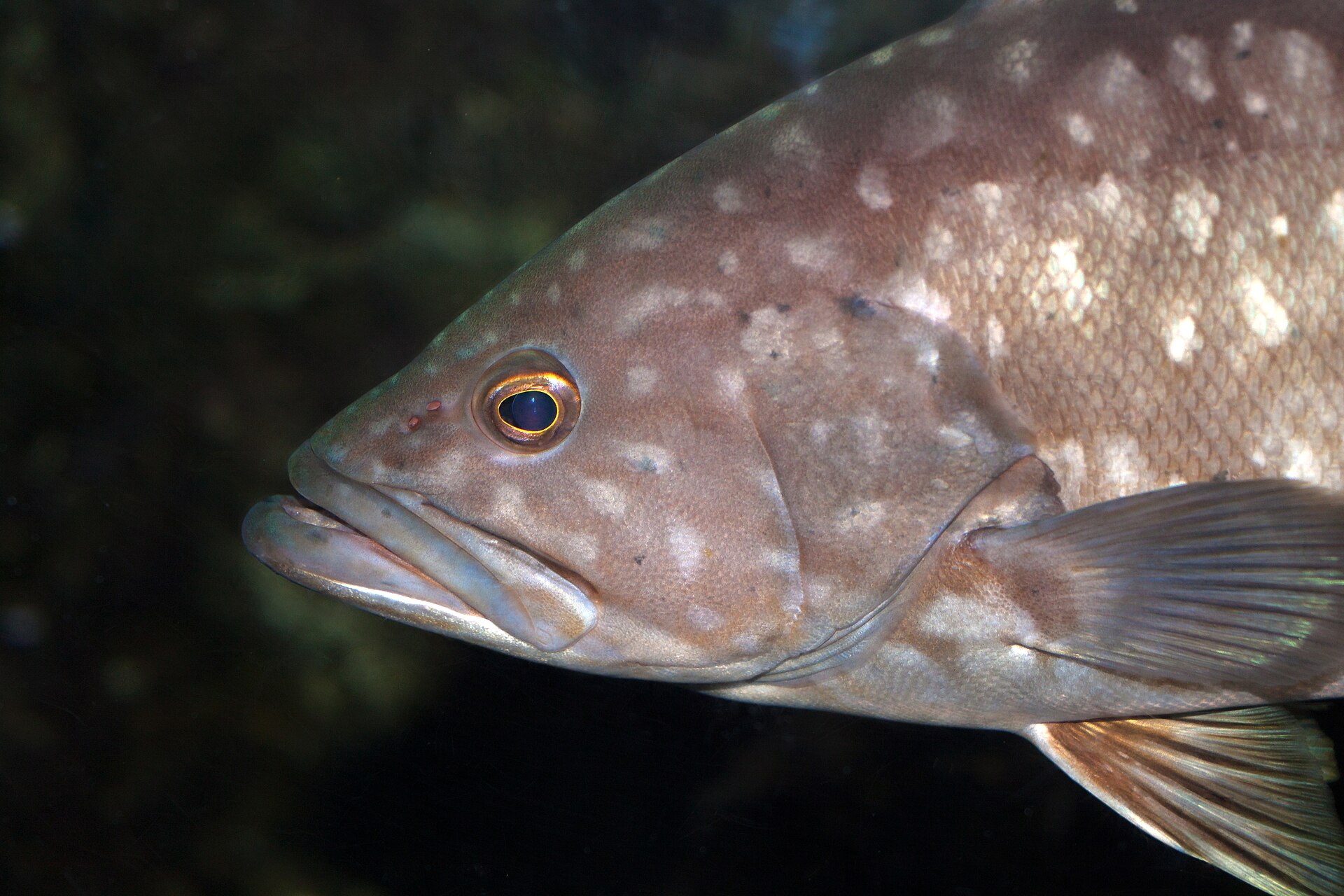
The dusky grouper has an oval, massive and powerful silhouette, topped by a large head with bulging eyes and a wide gaping mouth. Its livery ranges from brown to grey, sometimes tinged with red, and is adorned with irregular pale blotches forming a kind of “cloud” pattern. This colouring is not fixed: the grouper can lighten or darken it within moments depending on its mood and surroundings, which contributes to its excellent camouflage on rocky drop-offs.
Markings unique to each individual
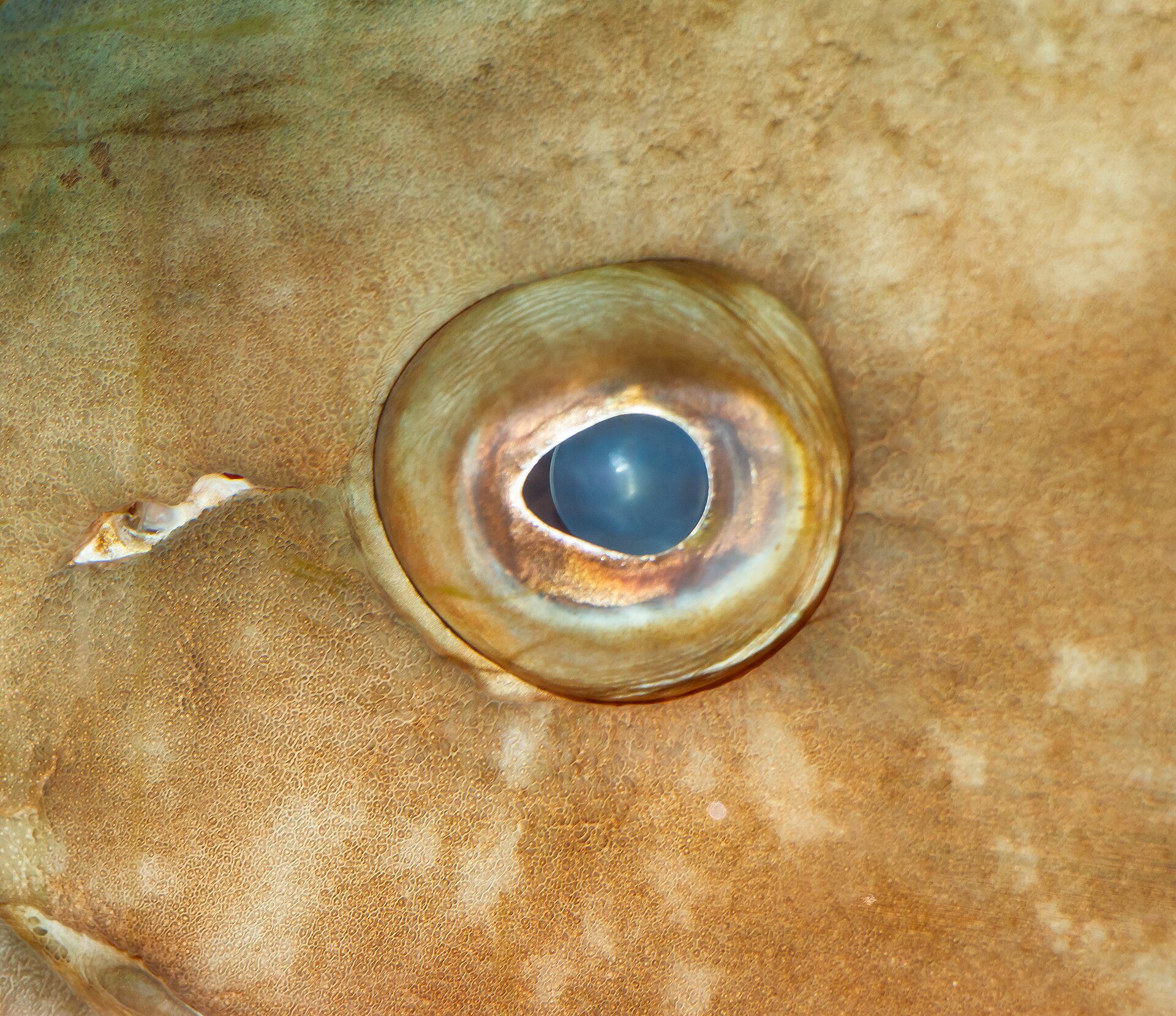
One detail delights naturalists: the grouper’s rounded tail fin is edged with a thin whitish border, while radiating marks around the eye form a “tear” and a “Y” pattern. These designs, unique to each fish, allow divers and scientists to identify individuals one by one and follow their movements year after year on the same site.
Size and lifespan
The dusky grouper is a fish that takes its time: it grows slowly and lives a very long time. The individuals encountered commonly measure 40 to 80 cm, but the oldest exceed one metre twenty and weigh over 50 kg. Here are the main biometric benchmarks for the species:
| Features | Reference point |
|---|---|
| Common size | 40 to 80 cm |
| Maximum size | about 1.40 m |
| Typical weight | 5 to 25 kg |
| Maximum weight | 50 to 60 kg |
| Longevity | up to 50 years |
| Sexual maturity (female) | 4 to 5 years |
Where does the grouper live?
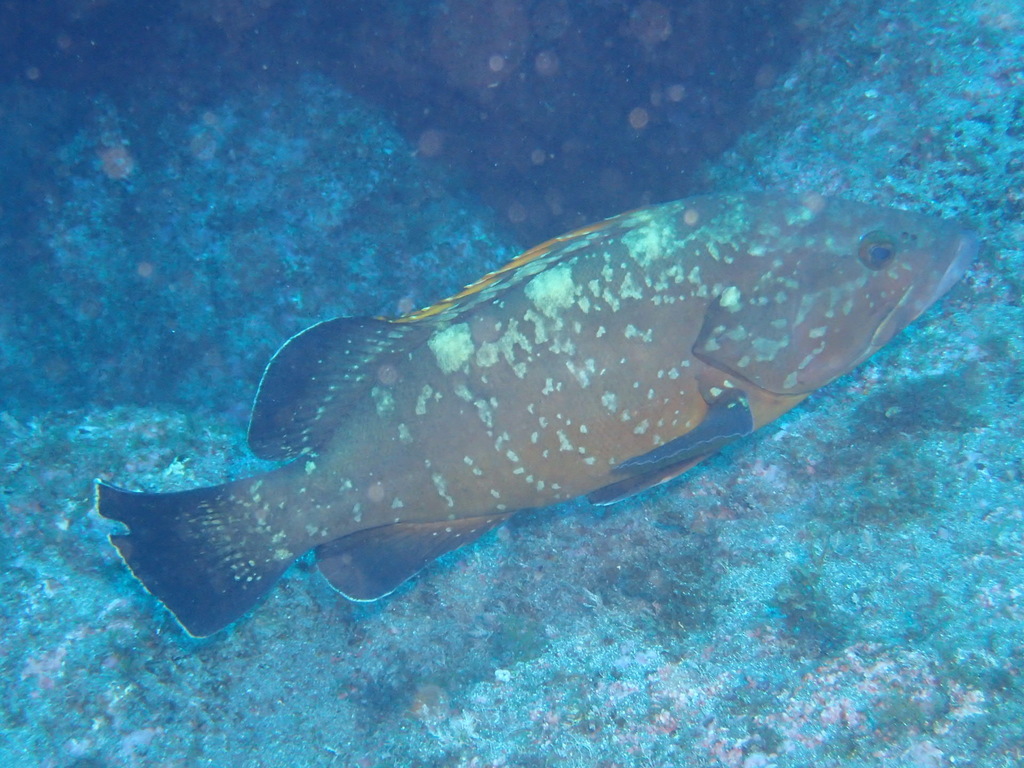
The dusky grouper is a fish of rugged rocky seabeds, rich in cavities, crevices and caves that provide it with plenty of shelter. It is most often found between 5 and 50 metres deep, down to around a hundred metres for the largest individuals. Deeply sedentary, it adopts a favourite crevice and stays loyal to it for years — a trait that sadly makes it easy to locate, and therefore vulnerable.
Its range covers the entire Mediterranean and the Eastern Atlantic, from the coasts of Brittany down to South Africa, with sightings as far as Madagascar and Réunion. In France, it is mainly observed along the mainland Mediterranean coast and around Corsica, especially in marine protected areas such as Port-Cros National Park, Calanques National Park or the Scandola reserve, where populations are faring best. These sanctuaries play a decisive role in the species’ return.
What does the grouper eat?
The grouper is a carnivorous, opportunistic predator, an ambush hunter rather than a pursuer. Lurking at the entrance to its crevice, it lies in wait for its prey and catches it with a brutal suction technique: the explosive opening of its vast mouth creates a vacuum that engulfs the prey in a fraction of a second. Its diet changes with age:
- Cephalopods : octopus, cuttlefish and squid, of which it is particularly fond.
- Crustaceans : crabs and other decapods, the staple diet of younger fish.
- Fish : small rock fish caught from ambush, a growing part of the menu in adults.
This position as an apex predator makes the grouper a key link in the balance of Mediterranean rocky seabeds.
Grouper life cycle and reproduction
The dusky grouper has an extraordinary life cycle: it is a protogynous hermaphrodite. In other words, each individual is born and first reproduces as a female, before changing sex to become male as it ages. This switch generally occurs between 10 and 14 years old, when the fish reaches 60 to 70 cm. Beyond 15 years and 80 to 90 cm, the vast majority of individuals have become males.
This peculiarity has a serious consequence: by taking the largest individuals, fishing removes the breeding males first, which severely unbalances populations. It is one of the main reasons the species is protected. Reproduction takes place in summer, when mature groupers gather on rocky areas for spectacular courtship displays.
| Parameter | Data |
|---|---|
| Type of reproduction | protogynous hermaphroditism |
| Maturity (female) | 4 to 5 years (40-50 cm) |
| Sex change | 10 to 14 years (60-70 cm) |
| Spawning period | July to September |
| Depth of gatherings | 15 to 30 m |
| Fertilisation | in open water |
Regulations: the grouper moratorium
In Mediterranean France, the dusky grouper enjoys strong legal protection in the form of a moratorium. Introduced as early as 1993, it first banned spearfishing for grouper, before being extended to hook-and-line fishing in 2002. Renewed several times, it was extended at the end of 2023 for a period of ten years.
What the current moratorium says
Regional prefectoral orders (Provence-Alpes-Côte d’Azur for the mainland Mediterranean, and Corsica) prohibit, until 22 December 2033, spearfishing and all hook-and-line fishing for grouper along the entire French Mediterranean coast. The protection does not only concern the dusky grouper: it covers several grouper species (golden grouper, white grouper, mottled grouper) as well as the wreckfish. These texts are subject to change: we encourage you to always check the regulations in force and the prefectoral orders for your area before any trip out to sea.
Grouper fishing: a special status
Let’s be clear: the grouper is not a species to target. In French Mediterranean waters, fishing for it is prohibited in all its recreational forms — spearfishing and rod-and-line fishing alike — because of the moratorium described above. Elsewhere, in areas where the species is not under a moratorium, catching it remains extremely regulated and, given its conservation status, strongly discouraged.
Our position, as anglers and lovers of the marine environment, is unambiguous: the grouper is to be encountered, observed and photographed, but not fished. Its sedentary nature, slow growth and late sex change make it an extremely fragile species, and every large individual taken takes decades to replace.
To better understand the animal and the context of its protection, here is a short documentary about the dusky grouper, king of the Mediterranean rocks:
Sea fishing that respects the species
Since the grouper is not to be fished, we obviously offer no selection of lures to target it — that would go against everything we stand for. However, sea anglers who want to enjoy lure fishing in the Mediterranean have perfectly legal and sporting species at their disposal, starting with the sea bass (known locally as loup). For that, see our dedicated guides:
- Our reference selection: 10 essential lures for bass fishing
- Must-have soft lures: best soft lures for bass
- Mediterranean special: the best lure for sea bass in the Mediterranean
- For surface strikes: surface lures for bass
And if you come across a grouper on your outings, the best thing to do is to leave it in peace and savour the privilege of sharing a few moments with this peaceful giant.
Grouper records and remarkable sizes
The dusky grouper is among the largest coastal fish in the Mediterranean. Naturalist sources (such as the FFESSM’s DORIS database) agree on a maximum size of around 1.40 m with a weight that can exceed 50 to 60 kg, and an exceptional lifespan of around fifty years. Given the moratorium and the species’ status, we deliberately do not showcase any catch “records”: the real achievement today is to come across the same old grouper on its territory year after year, living proof that protection works.
Ecological role and conservation of the grouper
As an apex predator, the grouper acts as a regulator on rocky seabeds: by controlling populations of fish and cephalopods, it contributes to the balance and good health of coastal ecosystems. Its presence, and above all that of large individuals, is considered an excellent indicator of the richness and preservation of a marine environment.
Decimated by decades of overfishing, the species is now listed as “Endangered” on the IUCN global Red List. But the grouper’s story is also one of an encouraging comeback: thanks to the moratorium and marine protected areas, its numbers are slowly rising along the French and Monegasque coasts. As responsible anglers, we have a role to play: respecting the regulations, never targeting the species, and supporting conservation efforts. That is the price of the grouper continuing to watch over the rocks of the Mediterranean.
Grouper FAQ
Can you fish for grouper in France?
No, not in French Mediterranean waters. A moratorium prohibits spearfishing and hook-and-line fishing for grouper along the entire mainland and Corsican Mediterranean coast until 22 December 2033. Always check the regulations in force and the prefectoral orders for your area.
How big can the dusky grouper grow?
The dusky grouper commonly measures 40 to 80 cm. The largest individuals can reach about 1.40 m and weigh 50 to 60 kg, with a lifespan that can approach 50 years.
Why is the grouper protected?
Its slow growth, strongly sedentary nature and late sex change make it very vulnerable to overfishing. Long decimated, it is listed as “Endangered” by the IUCN, which justifies the moratorium and the protection measures it enjoys in the Mediterranean.
What does the grouper feed on?
The grouper is an ambush predator that feeds mainly on cephalopods (octopus, cuttlefish, squid), crustaceans and fish. It catches its prey through powerful suction by suddenly opening its wide mouth.
Why is the grouper said to change sex?
The dusky grouper is a protogynous hermaphrodite: it is born and first reproduces as a female, then changes sex to become male, generally between 10 and 14 years old, at around 60 to 70 cm.
Where can you see groupers in the Mediterranean?
Groupers are mainly seen in marine protected areas, such as Port-Cros National Park, Calanques National Park or the Scandola reserve in Corsica, where populations are densest. Respectful scuba diving and freediving remain the best way to encounter them.